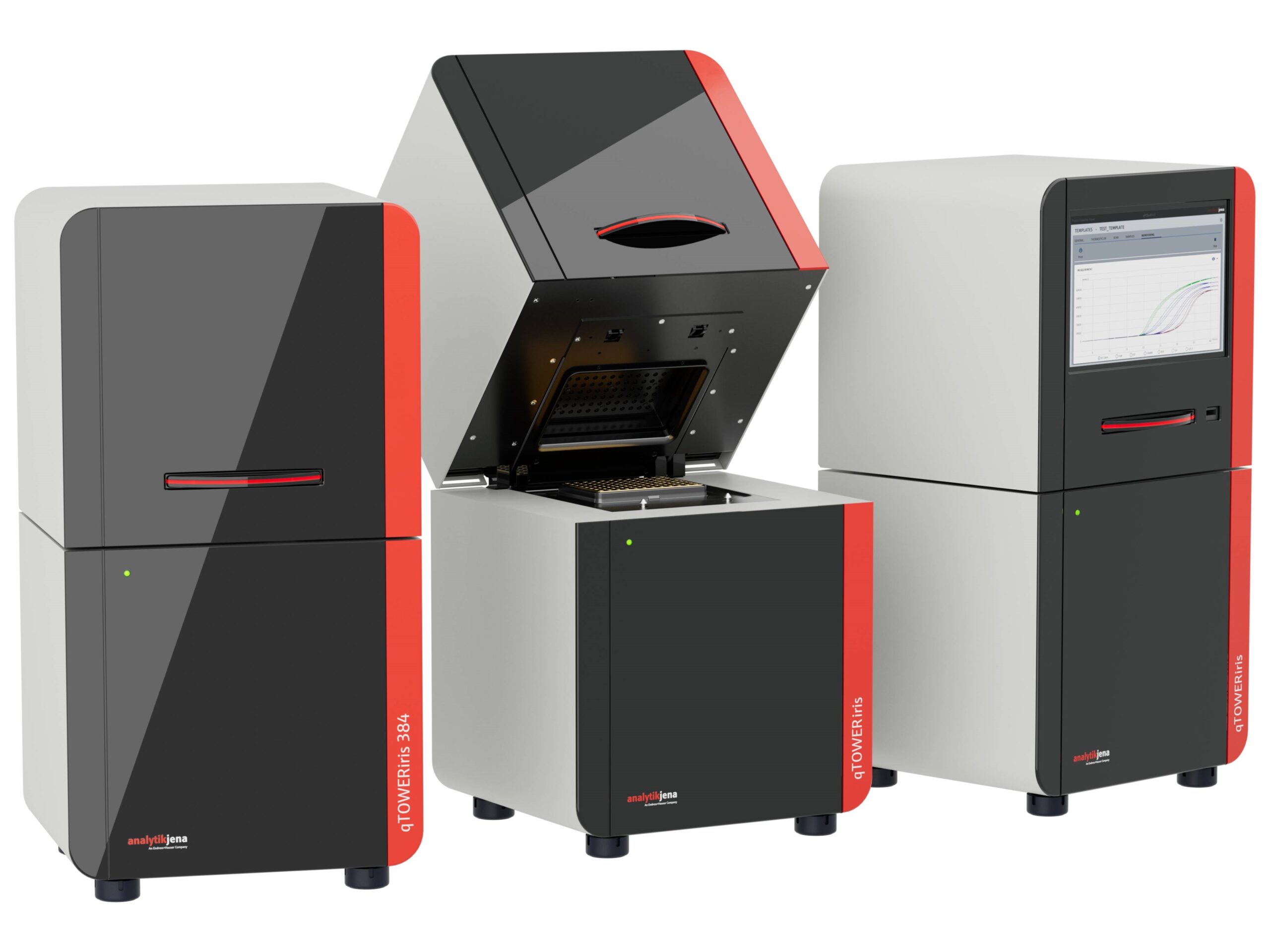


In the Life Science technology area Analytik Jena is pooling its biotechnological competence. It provides a wide product spectrum for automated total, as well as individual solutions for molecular diagnostics.
Accelerate to discover
Back to filter
Related topics

High-Throughput UVA-Based Thermal Shift Assays for Hydrophobic Proteins Using the qTOWER iris
Real-time PCR thermal cyclers of the qTOWER iris series, in combination with color module 7, enable rapid and precise assessment of protein thermal stability in both 96- and 384 well formats, including for membrane proteins. This allows efficient screening of storage conditions to maximize protein stability and evaluation of the effects of small compounds, ligands, or cofactors on hydrophobic proteins.
The excitation and emission wavelengths of the dyes are perfectly matched to color module 7, allowing selection of different fluorophores such as 1,8-ANS or CPM depending on the protein. The high-performance optical system detects minute changes in fluorescence, while the accurate and homogeneous temperature control of the thermal block enables high-resolution melting curves to reliably determine melting temperatures. Melting curve analysis in qPCRsoft further facilitates data interpretation by computing Tm values directly from the derivative of fluorescence data. 1,8-ANS binds to hydrophobic surfaces that become exposed during unfolding. Compared to SYPRO Orange, it exhibits lower nonspecific binding to detergents and provides clearer signals upon thermal unfolding, making it particularly suitable for studying membrane proteins in near-native environments. In contrast, CPM is a thiol-reactive dye that selectively reacts with free cysteine residues, which are 8 High-Throughput UVA-Based Thermal Shift Assays for Hydrophobic Proteins Using the qTOWER iris often buried in the native state and only accessible upon denaturation. CPM provides sensitive detection of unfolding without interference from detergents and has been success fully applied in stability studies of ABC transporters and other membrane-bound proteins. UV dyes are sensitive to light, temperature, and environmental conditions. To ensure reproducible and reliable results, it is essential to:
- Pipette rapidly and precisely to minimize exposure and prevent degradation.
- Work on cooling blocks or ice to maintain stability during handling.
- Perform experiments in a darkened area to protect dyes from photochemical degradation.
- Avoid direct sunlight during preparation and storage.
Strict adherence to these handling conditions is crucial for high-quality, reproducible data, as even small deviations can significantly affect fluorescence intensity and result comparability.
Related technologies: Liquid HandlingAutomated sample preparationAutomated nucleic acid extractionHigh-performance standard PCR and qPCR thermal cyclers