


The whole-slide, highly multiplexed biomarker imaging platform - depth and flexibility with the convenience of a comprehensive, rapid, single cycle process.
Accelerate to discover
Back to filter
Related topics

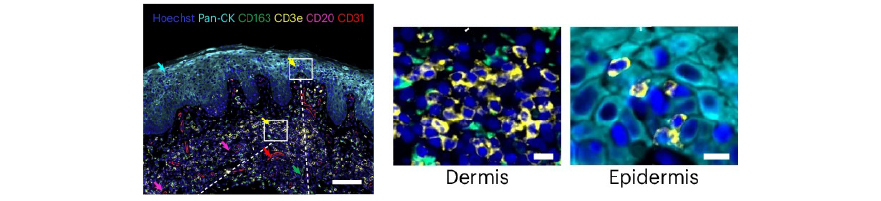
Cutaneous T cell lymphoma atlas reveals malignant TH2 cells supported by a B cell-rich tumor microen
Key Methodology: RareCyte Orion & Multi-Omics
The researchers employed a multi-modal approach to bridge the gap between single-cell data and tissue architecture:
- RareCyte Orion Platform: This high-plex fluorescence imaging technology was pivotal for spatial validation. Unlike traditional methods, Orion allows for “one-shot” staining of numerous biomarkers (multiplex protein immunofluorescence) on a single FFPE (formalin-fixed paraffin-embedded) slide.
- Role in Study: It was used to visualize the exact positioning of malignant T cells relative to other immune cells, specifically confirming the presence of B cell aggregations and tertiary lymphoid structures (TLS) in situ.
-Integration: The methodology integrated scRNA-seq (from 45 patients) with 10x Visium Spatial Transcriptomics and the Orion protein imaging to ensure that findings from dissociated cells matched the physical reality of the tumor tissue.
Key Findings
- Malignant Identity: The study confirmed that malignant cells in CTCL predominantly resemble T helper 2 (TH2) cells, which are typically associated with allergic responses.
- The “B Cell Support” System: A major discovery was the enrichment of B cells, plasma cells, and mast cells in the CTCL microenvironment—cells not typically found in healthy skin or other inflammatory conditions like psoriasis.
- Microenvironment Niche: Malignant TH2-like cells were found to be supported by MHC-II+ fibroblasts and dendritic cells. In progressive disease, these malignant cells specifically aggregated with B cells, forming organized structures that likely promote tumor survival and evasion of the immune system.
Importance of Spatial Biology
The use of spatial biology (via Orion and Visium) was critical for this research because:
- Beyond “Cell Soup”: While single-cell sequencing tells us which cells are present, spatial biology tells us where they are and who they are talking to.
- Structural Insight: It identified Tertiary Lymphoid Structures (TLS)—organized clusters of immune cells—as a hallmark of progressive CTCL. Understanding these structures is vital for developing therapies that can disrupt the “neighborhood” the tumor relies on to grow.
- Clinical Precision: By mapping the spatial relationship between malignant cells and B cells, the study suggests that CTCL might be treated not just by targeting the T cells, but by disrupting the B cell-rich microenvironment that feeds them.
Related technologies: Automated microscopy and image analysisAutomated microscopy and Spatial Proteomics