

In the Life Science technology area Analytik Jena is pooling its biotechnological competence. It provides a wide product spectrum for automated total, as well as individual solutions for molecular diagnostics.
Accelerate to discover
Back to filter
Related topics


Standardized Thawing and Sample Preparation of ARCTis™ Cryopreserved Human Tumor Cells
Introduction
The standardized and automatic handling of cryopreserved biological samples plays an increasingly important role in today’s in vitro testing. This is due to the trend to develop more complex disease models to increase the data quality of pre-clinical studies in terms of biological relevance and, subsequently, their successful translation into medical trials. A major contributor is the development of 3D cell culture methods generating spheroid-shaped microtissues, in particular the dawn of patient-derived models over the last two decades. However, these more sophisticated cell models demand improved handling protocols in comparison to 2D cell culture models. Furthermore, they are either in-house developments of pharmaceutical research labs or supplied by specialized manufacturers. The latter typically provide them as assay-ready consumables to researchers worldwide. This is, on the one hand, a challenging logistical effort and, on the other hand, it means that a researcher must start testing directly once the material arrives.
In this regard, providing such biomaterials cryopreserved is a liberating development. It simplifies supply chains and gives users the freedom to choose when to perform their studies. Although handling cryopreserved cells from cryovials and converting them into a 2D cell culture is a daily routine for most laboratories, the thawing of in-plate frozen cells optimized to form a 3D spheroid directly after thawing is not. This demands a robust protocol yielding high cell viability, as reducing the number of dead cells positively impacts spheroid formation. A defined protocol optimized for this parameter can be easily implemented by using the CyBio FeliX instrument from Analytik Jena.
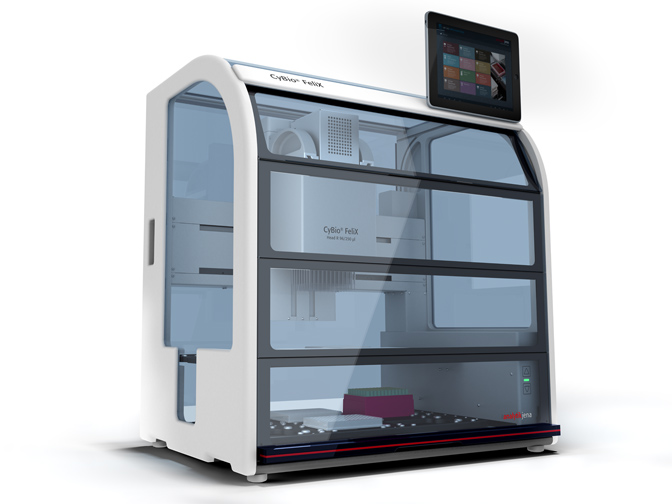
CyBio FeliX is a compact and highly adaptable liquid handling platform designed for a wide range of automated workflows. Automation significantly enhances reproducibility and minimizes the risk of human error. Due to its small footprint and 12-position deck layout, CyBio FeliX can be placed inside a clean bench while maintaining flexibility for diverse applications. Configurations can be tailored to the specific requirements of each workflow. In this setup, the system integrates a heating element (BioShake 3000-T elm) for thawing, as well as modules for cell culture plate handling and lid management. Cell culture maintenance through media exchange is performed using the multichannel pipetting head R 96/250 µL, which enables parallel processing of up to 96 samples. Additionally, the pipetting head can target specific positions inside the wells, enabling adaptation to the specifications of the ARCTis™ Human Tumor Microtissue Plate from InSphero. This ensures that the tips operate along a defined edge, thereby preventing spheroid disintegration or loss during plate handling.
Methods on CyBio FeliX
Detailed protocol description
- Set up CyBio FeliX according to prompts from the dialog box in the CyBio Composer software, placing the two reservoirs, the two CyBio RoboTipTrays 96/250 µL, the Gripper, and the BioShake 3000-T elm in their respective positions.
- Fill 30 mL of ARCTis™ Aggregation Medium into the single-well reservoir.
- Transfer the ARCTis™ Plate from the–80 °C freezer to the biosafety bench using a bucket with dry ice.
- Start the thawing protocol in CyBio Composer until prompted to place the plate on the BioShake 3000-T elm.
- Remove the ARCTis™ Plate from its packaging, place it on the BioShake heater (37 °C), and continue the thawing protocol in CyBio Composer. It takes roughly 3 minutes to thaw the plates completely.
- CyBio FeliX pipettes ARCTis™ Aggregation Medium in four steps (20, 20, 60, and 80 µL) into each of the 96 wells, diluting the 20 µL cell suspension with its cryoprotective agent tenfold.
- When prompted by the software, transfer the ARCTis™ Plate to the centrifuge and spin at 250 rpm for 2 minutes.
- Continue the preparation protocol in CyBio Composer, which will first remove >90% of the liquid and then add 50 µL of fresh ARCTis™ Aggregation Medium to each well.
- At the end of the preparation protocol, the user is notified by a prompt in CyBio Composer and should then transfer the plate into an incubator.
A similar procedure can be programmed to thaw and process up to four ARCTis™ Human Tumor Microtissue Plates in one run. In this case, lid handling and placement of the plate on the BioShake must be performed manually, as the required number of deck positions exceeds the available 12 positions on the CyBio FeliX deck.
General advantages of using CyBio FeliX:
- Process consistency
- 20% faster than manual processing
- Upgrade option for minimal user interaction (combination with an external robotic arm and automated centrifuge)
- Various plate adapters for the BioShake enabling a fast and robust thawing process
Results and Discussion
A fast and reliable thaw rate is the single most important parameter when thawing cryopreserved biomaterials. The goal is to avoid recrystallization of water ice during the process, as it can harm the cells. Furthermore, a short thawing process allows quicker removal of the cryopreserving agent, which is important because most of these agents have cytotoxic properties.
Two different BioShake adapters were tested with two temperature settings: 37 °C and 70 °C. For the higher temperature setting, the exposure time of the ARCTis™ Human Tumor Microtissue Plates was adjusted to avoid overheating and damaging the cells. The thaw rate for both adapters, despite their different geometry, was found to be comparable, although the wider well design of Adapter I resulted in slightly less efficient heat transfer into the microplate.
To measure the thaw rate, the temperature inside the wells was monitored. Eight K-type thermocouples were positioned in wells across Akura™ test plates. The plates were then filled with a cryopreservation agent identical to that used in ARCTis™ Human Tumor Microtissue Plates to replicate product behavior. Prior to testing the thawing procedure, the plates were cooled to–80 °C.
The results show a much steeper thaw rate at 70 °C, which is preferable. However, for manual plate thawing this would be risky, as there is a possibility of overheating the cells if the plate is not removed from the heater in time. Using a lab automation instrument such as CyBio FeliX eliminates this risk. After 1 minute, the plate is automatically transferred off the heater and placed at a new deck position. The cryopreservation agent is then diluted immediately. The main advantage for the user is the higher thaw rate, rather than simply reducing the overall process time by four minutes.
The morphology of HCT116 tumor microtissues shows no significant differences between conditions, which is one of the main evaluation criteria for such cancer models. Size, shape, and edge smoothness are characteristic parameters for each tumor model. Furthermore, metabolic activity is a strong indicator of spheroid viability and, consequently, of thawing success. It is measured as pg of ATP turnover per spheroid, typically on day 5 after thawing. In addition to ATP turnover, viability is assessed by comparing spheroid size on day 5 after thawing.
The size comparison reveals no significant differences among the four thawing conditions. Moreover, all four conditions show comparable ATP levels per spheroid (30 pg/MT ± 5 pg), fulfilling the quality criteria for the HCT116 cancer model.
Summary
The CyBio FeliX instrument enables robust thawing of microplates containing cryopreserved cancer models such as the ARCTis™ Human Tumor Microtissue Plates with minimal user interaction. By optimizing thawing parameters for the BioShake heater within the protocol, the thaw rate can even be doubled, which is particularly important for more sensitive tumor models.
The solution presented here is simple, effective, and easily scalable to process varying numbers of plates without redesigning the core assay workflow. Automating the thawing process minimizes user intervention and reduces potential errors associated with manual pipetting. Furthermore, the compact footprint and flexible deck configuration allow integration into clean benches and adaptation to complex workflows. Automated handling improves reproducibility, reduces error-prone manual tasks, and enables laboratory staff to focus on analytical work rather than repetitive procedures.
Related technologies: Liquid HandlingAutomated sample preparation